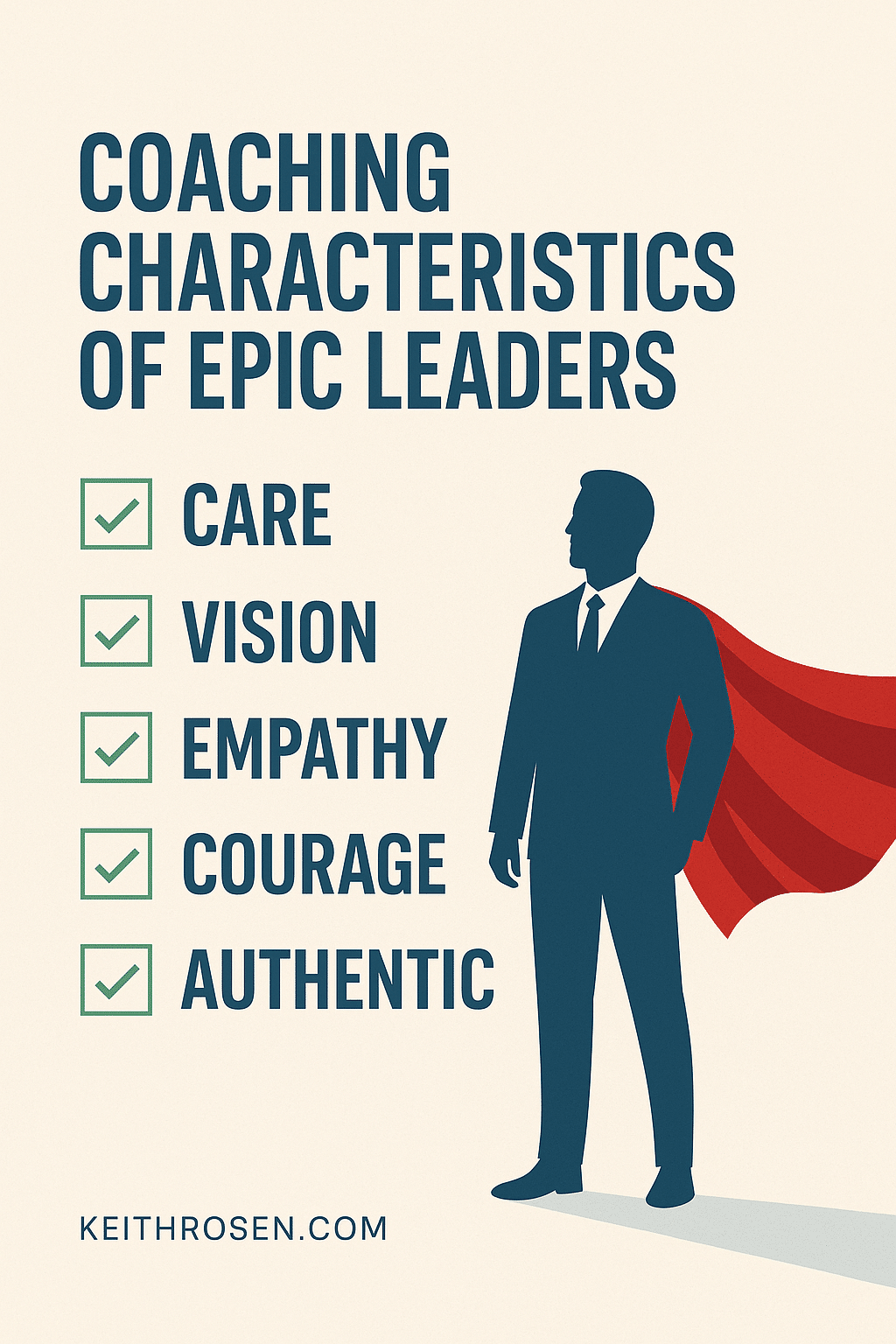
There’s so much confusion and inconsistencies around what coaching really means and what great coaching looks and feels like. Here are 14 coaching characteristics that the best leaders emulate every day, and in every conversation.
Making the shift from manager to leader isn’t just a change in title; it’s a change in how you manage and lead your team. It requires giving up control, letting go of having all the answers, and risking vulnerability in service of something bigger: your people. That’s the cost.
The benefit? Everything. Stronger teams. Deeper trust. Self-accountability. And elevating the kind of culture where growth isn’t forced but embraced and part of your rhythm of your day.
Most managers avoid this transformation because it’s uncomfortable. The best ones lean into it because they know: you can’t develop others until you’re willing to develop yourself.
1. Models What’s Possible.
You can’t take someone where you haven’t been yourself. The best leaders model what’s possible for others to achieve. Culture follows leadership.
2. Knows When to Give the Answer.
Sometimes people don’t need a question, they need a roadmap. If the coachee hasn’t lived it, been trained on, or experienced something, it’s time to train, not coach.
3. Coach from the Heart.
While there are best practices of great coaching, the best coaches coach from their heart, not from their head. It comes from within. Coaching becomes who you are, not something you “do.”
4. Owns Their Style.
They’re not leadership clones. Like all great athletes, the best coaches create their own voice. Their authenticity is what makes them magnetic.
5. Listens More Than talks.
They don’t just listen to what someone is saying with the intent to respond. They intentionally listen deeply ‘for’ certain things, such as fears, goals, assumptions, knowledge gaps, self-awareness and limiting beliefs. It’s where reflection lives. Silence = Care.
6. Asks Powerful Questions.
Instead of being their team’s ChatGPT and go-to Chief Problem Solver that creates dependency, they ask questions that make people think, self-reflect and grow.
7. Holds People Capable, Not Just Accountable.
They believe in their team’s potential even when their team doesn’t and coaches them to achieve what they didn’t think was possible.
8. Gives Feedback That Fuels, Not Flattens.
Feedback isn’t a grenade that makes people wrong. It’s a flashlight that recognizes growth opportunities that empower.
9. Coaches In The Moment.
They don’t wait for 1-on-1s. Every conversation is a coaching conversation.
10. Models Self-Awareness.
They authentically own their flaws and blind spots, and invite their team to call them out. To develop trust, coaching goes both ways.
11. Develops People, Not Just Performance.
When you focus on the primary objective of leadership, which is, to make your people more valuable every day, the numbers become a byproduct of your coaching.
12. Celebrates Effort, Not Just Outcomes.
They don’t only coach when there’s a challenge. They coach the win to reinforce best practices. They acknowledge risk, learning and resilience because growth isn’t easy.
13. Lives In The Present Moment.
The consequence of focusing on the numbers forces you to live in the future. Instead of focusing on what’s next, focus on what’s now to observe and recognize growth opportunities. Active listening and the creation of new possibilities can only occur in the present. It’s also where life happens.
14. Detaches From Their Own Agenda.
When someone comes to them for help, they don’t disguise coaching as manipulation, using leading questions to guide the coachee to where they want them to be. Instead, they focus on each person’s individual agenda and goals and allow the conversation to flow organically, rather than push for the outcomes they want.
The greatest leaders aren’t just skilled communicators, they’re catalysts for transformation
What sets them apart isn’t just what they know, or the experiences they had, but how authentically they show up.
For every manager, coaching is no longer just a skill and way of communicating,. It’s a responsibility. One that requires courage, vulnerability, and an unshakable commitment to the growth of others and yourself.
The leaders who embrace this shift elevate cultures where people grow in every area of their lives, not just perform. When you embody these traits, you no longer only manage outcomes but also start balancing that with helping people achieve what they may never thought possible in addition to becoming who they want to be.