A conversation with a gifted custom motorcycle builder revealed why exceptional talent and hard work do not always create a profitable business. Sometimes growth begins by charging more and choosing the right customers. And a little sales coaching for business owners doesn’t hurt.
We were three and a half hours into a seemingly endless line crossing the border from Canada into the United States, and whatever patience we had started with was slowly being confiscated by customs.
That was when I met Ryan.
Ryan was in his thirties. As we talked, I come to find out how creative, hardworking and a remarkably talented entrepreneur he was. He owned a custom motorcycle paint shop in California where he built and painted motorcycles. This was not standard paintwork or assembly. Ryan created masterpieces on motorcycles that reflected the personality and vision each client wanted to capture.
As we started talking, I learned that, according to his customers, he was the only person who could do what he did at that level. His work required technical expertise, artistic talent, heightened creativity, precision and years of experience. He was not simply painting motorcycles. He was creating functional works of art.
Like many entrepreneurs, Ryan wanted to grow his business.
“I’m working hard,” he told me. “The problem is, whenever I take a break, the runway for my money doesn’t last very long.”
I understood immediately, and could relate. Ryan had built a business that depended almost entirely on his time, talent and physical presence. When he was working, money came in. When he stopped working, the income slowed down and the list of people who wanted him to paint their bike became longer.
His solution was the same one most hardworking business owners instinctively reach for.
Work more. Take on more projects. Put in more hours. Keep pushing.
But working harder was not going to solve the real problem. It was only going to make Ryan more exhausted inside the same business model.
So, I asked, “What do you charge for your work?” I asked.
He told me.
Then I asked, “What would happen if you charged double?”
Ryan immediately went to the fear most business owners have. The shocking look on his face told it all.
“I might lose some clients.”
“You probably would,” I said.
I wasn’t going to tell him that raising his prices would have no implication to his business, until he was able to see this is the right, most profitable, long term plan that would also require less work, and more life balance.
Some people shop primarily on price. They may admire the craftsmanship, compliment the finished motorcycle and tell everyone how talented Ryan is, but they still may not be willing to pay, or afford to pay what he charges for each project.
Losing some clients, however, is not necessarily losing business.
“What might you gain?” I asked.
He thought about it.
“More qualified clients that are more aligned with my view of an ideal client,” he said. “People who are willing to pay what the work is worth and appreciate the craftmanship.”
“And what would that do for your business?”
Ryan paused.
It was not the kind of pause that comes from confusion. It was the pause that happens when someone hears a question they have never been asked before.
Every client had told Ryan he should be charging more. They saw the uniqueness of his talent. They understood the quality of his craftsmanship. They recognized that what he created could not be purchased from the shop down the street.
Yet no one had helped him examine what charging more could make possible.
His clients had given him an opinion. Coaching helped him explore the impact.
Charging more could mean fewer projects while increasing his income. It could mean attracting clients who valued his artistry instead of negotiating over every dollar. It could give him more time to focus on the quality of each build, develop the business and create some financial breathing room.
More important, it could change his life for the better, not consume it.
“What would earning more from fewer, better-qualified clients allow you to do personally?” I asked.
That was the deeper question.
This conversation was no longer about the price of a custom painted motorcycle. It was about the cost of building a business that consumed the person who created it.
Ryan had become so focused on working harder that he had not stopped to consider whether his business was truly working for him. He was trying to extend his financial runway by running faster, when the better solution might be building a longer runway.
That is the trap many gifted entrepreneurs fall into. They become exceptionally good at their craft, but they never learn how to price, or scale, the value of that craft. They confuse being busy with being profitable and believe that working harder is the only respectable path to growth.
“Your price does more than determine what you earn. It determines which clients you attract, how you spend your time and the kind of life your business allows you to create.”
Ryan didn’t need more motivation. He was already motivated. He didn’t need to care more about his clients or improve the quality of his work. The quality was the reason people kept telling him to charge more.
He needed permission to see his own value differently.
“Sometimes the next level of growth isn’t about acquiring more customers. It requires the courage to charge what you’re worth, and choose better customers.”
But charging more is only part of the strategy. A higher budget does not automatically make someone a better client.
“You also need to define what makes someone a great client for you,” I said. “How will you know whether this person will respect your talent, trust your recommendations and appreciate the final product?”
Why Qualification is Essential
“Qualification is not about convincing everyone to hire you. It is about determining whether you and the client should work together.”
The wrong client can consume more time, question every decision, negotiate every dollar and drain the joy from the work. The right client values Ryan’s expertise, respects the process, communicates clearly and is willing to pay for something truly original.
“Growth is not only about increasing what you charge. It is about becoming more intentional about whom you allow into your business.”
If Ryan charged more, qualified carefully and completed fewer projects, he could earn the same amount or more while reclaiming his time. He could invest in the future of the business, instead of constantly racing to fund its present. He could take a break without immediately worrying about how quickly his money would disappear.
“Profit isn’t greed or about over-charging. Profit gives a talented business owner the freedom to continue creating without sacrificing the life the business was supposed to support. And ultimately, the space to create every unique masterpiece.”
By the time we were about to be called to the custom booth, Ryan was leaving with several questions he could no longer ignore.
1. What is my work truly worth?
2. Which clients do I want to serve?
3. How will I know whether someone is the right client?
4. What would charging appropriately make possible for my business?
5. What would it make possible for my life?
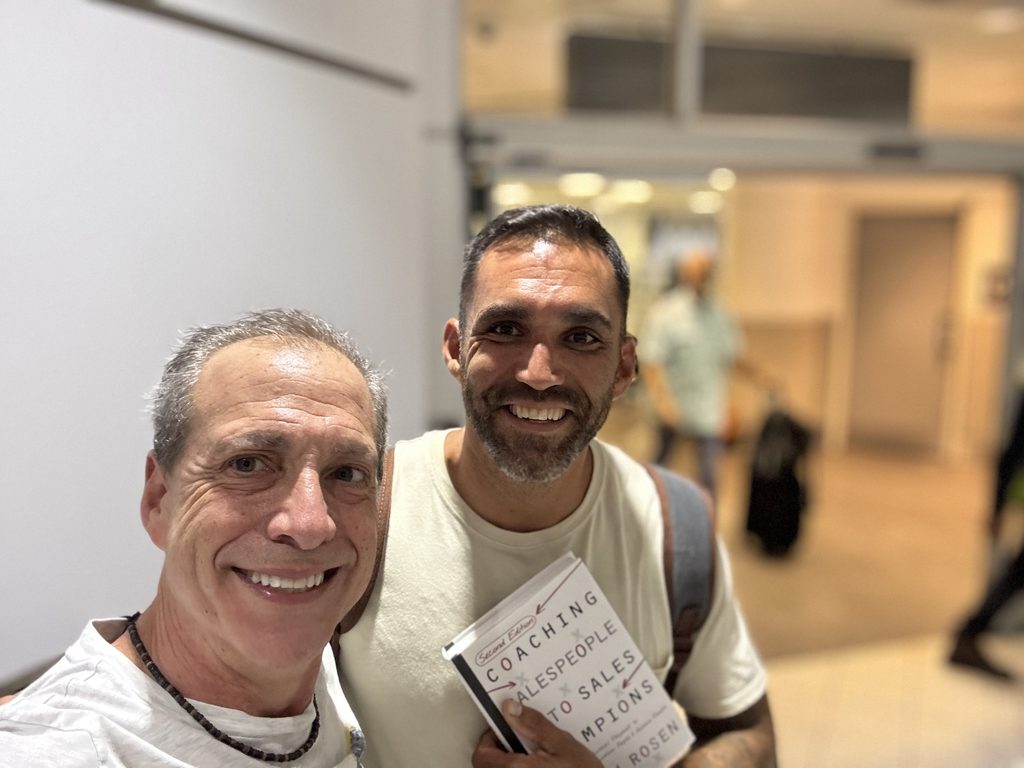
After we got through customs, I gave Ryan a copy of my book. The photograph of us together shows him holding it, but what the photograph cannot capture is the realization that unfolded during those three and a half hours.
Ryan already possessed the talent. His clients already recognized the value. Now it was time for him to build a business that honored both.
The border delay may have cost us three and a half hours. For Ryan, I hope the conversation gives him back years of his life.
⭐⭐⭐⭐⭐⭐⭐
If you’re interested in my sales coaching for business owners, contact me for personal 1:1 Business and Sales Coaching. And be sure to grab a Copy of My book Coaching Salespeople Into Sales Champions Second Edition on Amazon here.